
Choice Paralysis: Why We Can't Decide and How to Fix It
Published March 18, 2026 · Updated June 2026 · 14 min read · By SpinPickOnline Team
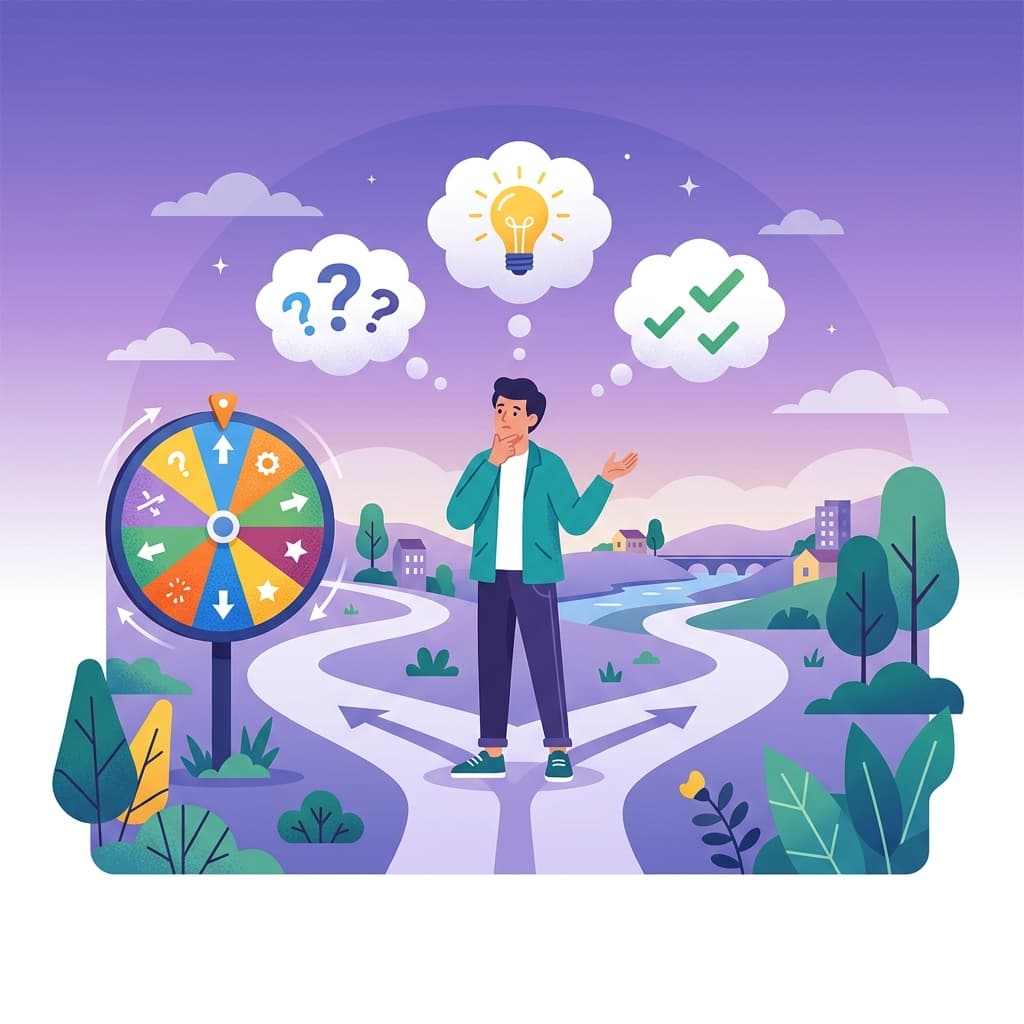
You've spent 40 minutes browsing Netflix without choosing anything and ended up watching something you've already seen. You've stood in a restaurant staring at the menu so long that the waiter has come back three times. You have seven tabs open comparing products that are essentially identical and still haven't bought one. If any of these scenarios feel familiar, you've experienced choice paralysis — and you're far from alone.
Choice paralysis (also called analysis paralysis or the paradox of choice) is a well-documented psychological phenomenon with real consequences for your productivity, happiness, and even your health. Understanding why it happens — and knowing practical strategies to overcome it — can transform your relationship with decisions big and small.
The Psychology: Barry Schwartz and the Paradox of Choice
In 2004, psychologist Barry Schwartz published The Paradox of Choice: Why More Is Less, drawing on decades of research to demonstrate a counterintuitive finding: more choices make us less happy, not more. His famous jam study (conducted with Sheena Iyengar) showed that shoppers who encountered a display of 6 jam varieties were 10 times more likely to make a purchase than those who encountered 24 varieties. More options, less action.
Schwartz identified two primary ways that excess choice makes us miserable: maximizers (people who need to find the objectively best option) suffer more than satisficers (people who select the first option that meets their criteria). If you find yourself unable to commit to a choice because there might be a better one out there, you are likely a maximizer, and more choices actively harm you.
🔬 Are You a Maximizer or Satisficer?
Schwartz developed a simple diagnostic: When you buy a product, do you continue checking reviews after purchasing to see if you made the best choice? When choosing a restaurant, do you check every option in a 5-mile radius? If yes, you're a maximizer — and research shows maximizers earn higher salaries but report lower happiness and more depression. The relentless pursuit of "best" undermines satisfaction with "great." Learning to satisfice — to choose the first option that meets your criteria — is one of the most powerful happiness interventions available.
Decision Fatigue: Why Willpower Is a Finite Resource
Related to choice paralysis is decision fatigue — the psychological exhaustion that comes from making too many decisions. Research has consistently shown that decision quality degrades as the number of decisions made in a day increases. Judges give harsher sentences later in the day. Doctors prescribe more default treatments in the afternoon. Shoppers make more impulsive purchases after browsing for long periods.
The problem is not a character flaw — it is neuroscience. The prefrontal cortex, which handles complex reasoning and self-control, is an energy-intensive organ that depletes over time. Every choice you make, no matter how trivial, draws on the same finite reserve. This is why Barack Obama wore the same suit colors, why Mark Zuckerberg wore the same gray t-shirt: eliminating trivial decisions preserves mental energy for decisions that matter.
The Hidden Cost of Overthinking
Choice paralysis isn't just inconvenient — it has measurable costs that compound over time:
| Cost | How It Manifests | Real-World Impact |
|---|---|---|
| Time | Spending 20+ minutes on trivial decisions | Estimated 2-3 hours per week lost to overthinking low-stakes choices |
| Energy | Cognitive depletion from constant evaluation | Poorer quality decisions on things that actually matter |
| Satisfaction | Post-decision regret and "what if" rumination | Lower happiness even when objectively better choices are made |
| Opportunity | Avoiding decisions entirely (inaction) | Missing out on experiences, delayed projects, stalled progress |
⚡ Signs You Have Decision Fatigue
- • Procrastinating on decisions that feel overwhelming
- • Making impulsive choices late in the day
- • Defaulting to "whatever you think" in group settings
- • Feeling exhausted by simple choices
- • Avoiding making decisions entirely
- • Regretting decisions disproportionately
🛡️ Protect Your Decision Energy
- • Make important decisions in the morning
- • Eliminate low-stakes daily decisions by habit
- • Delegate or randomize trivial choices
- • Set decision deadlines to prevent over-analysis
- • Use satisficing for reversible decisions
- • Batch similar decisions together
The Decision Framework: High-Stakes vs. Low-Stakes
Not all decisions deserve the same level of attention. The key to overcoming choice paralysis is learning to categorize decisions by their actual stakes and allocating effort accordingly:
🎯 High-Stakes Decisions
Deserve careful analysis:
- • Career changes and job offers
- • Major financial commitments
- • Relationship decisions
- • Health and medical choices
- • Moving to a new city
Strategy: Research, consult experts, sleep on it
🎲 Low-Stakes Decisions
Deserve minimal energy:
- • Where to eat lunch
- • What to watch tonight
- • Which comparable product to buy
- • Who presents first
- • What to order at a restaurant
Strategy: Spin a wheel, flip a coin, pick the first good option
7 Science-Backed Strategies to Overcome Choice Paralysis
Limit Your Options Deliberately
Before deciding, filter your options down to three or fewer. Research consistently shows that three options produce better outcomes and greater satisfaction than ten. If you are choosing a restaurant, pick three candidates before opening any menus. Apply the same principle to shopping: narrow your search to 3 finalists, then choose. This is not limiting yourself — it's freeing yourself.
Set a Decision Deadline
Give yourself a specific time limit: "I will decide in the next 10 minutes." A timer adds productive pressure and stops the open-ended rumination that characterizes analysis paralysis. Research on time pressure shows that moderate deadlines actually improve decision quality. For online shopping, try the "24-hour rule" — if you still want it tomorrow, buy it. Most items, you won't even remember.
Use the 10-10-10 Rule
Ask yourself: How will I feel about this decision in 10 minutes? 10 months? 10 years? This perspective shift quickly reveals which decisions are truly high-stakes (worth careful analysis) and which are trivial (worth a quick random pick). If the answer to all three is "it won't matter," stop deliberating and decide immediately.
Spin a Wheel for Low-Stakes Choices
For reversible, low-stakes decisions — where to eat, what to watch, who speaks first — stop deliberating and randomize. A decision wheel or coin flip is not avoiding the decision; it is correctly allocating your mental resources. Using a tool like SpinPickOnline's decision wheel means the choice is made in seconds with zero cognitive cost. Interestingly, research also shows that when people flip a coin and don't like the result, they instantly know what they actually want — the randomization reveals hidden preferences.
Adopt a 'Good Enough' Standard
Practice satisficing: define minimum criteria for an acceptable choice, then pick the first option that meets them. Stop looking for the objectively best option; it probably doesn't exist, and the search for it will cost you more than any quality differential between options. Set your criteria before you start looking, then commit to the first match.
Accept That Most Decisions Are Reversible
Humans systematically overestimate how permanent decisions are. The majority of choices you agonize over can be changed, returned, revised, or corrected. Decision anxiety is worst when we treat every choice as permanent. Actively reminding yourself that a decision can be reversed reduces the psychological stakes and makes action easier. Ask: "What's the worst that happens if I change my mind?"
Build Decision Routines
Systematize recurring decisions. Meal prep on Sundays eliminates daily "what's for dinner?" Capsule wardrobes eliminate "what should I wear?" Automating repeated decisions is not laziness — it is neuroscientific efficiency that reserves your cognitive resources for decisions that cannot be routinized. Start by identifying the 3 decisions you make most frequently and creating a default for each.
When to Use a Random Decision Tool
There is a category of decisions where randomization is the optimal strategy: choices where all options are roughly equivalent in quality and the decision is reversible. This includes where to eat lunch, what movie to watch, who presents first, which of two comparable products to buy, and which task to tackle next from a list of equal priorities.
For these decisions, extended deliberation produces no better outcome than a random pick — but costs significant time, energy, and mental bandwidth. A yes/no wheel or lunch decision spinner is not a crutch; it is rational optimization. Spend your decision-making energy on the choices that actually warrant it: career moves, major purchases, relationship decisions.
💡 The Hidden Power of Random Choices
Here's a surprising finding: people who delegate low-stakes decisions to randomness often discover new favorites they never would have found through deliberate choice. When the wheel picks a restaurant you wouldn't normally choose, or a movie outside your usual genre, it breaks you out of habitual patterns. Some of the best experiences come from choices you didn't make yourself. Randomness is an underrated discovery mechanism.
Key Takeaways
- ✓ More choices make us less happy and less likely to decide (the Paradox of Choice)
- ✓ Decision fatigue is real neuroscience — every trivial choice depletes the same energy reserve
- ✓ Categorize decisions as high-stakes or low-stakes and allocate effort accordingly
- ✓ Use randomization (spin wheels, coin flips) for low-stakes, reversible decisions
- ✓ Practice satisficing: "good enough" is almost always better than "perfect"
- ✓ Build decision routines to eliminate recurring trivial choices entirely
Related Reading
10 Decision-Making Tips
Practical tips for faster, better decisions
Creative Uses for Random Number Generators
Beyond basic randomness
Stop Overthinking. Start Deciding.
Use our free decision wheel for low-stakes choices so you can save your mental energy for what matters.